Recent major biopharmaceutical manufacturing announcements are positioning Virginia for a broader reshoring effort in the pharma industry. COVID-era supply chain disruptions and resulting shortages exposed the risks of over-reliance on overseas production for essential medicines. Since then, domestic pharmaceutical manufacturing has become a focus of federal policy and private capital, promising economic growth and thousands of well-paying jobs.
Since late 2025, AstraZeneca, Eli Lilly and Company, and Merck have announced more than $12.5 billion in capital investment across Virginia’s life sciences sector. As part of that effort, the companies also committed $120 million to develop the Virginia Center for Advanced Pharmaceutical Manufacturing, a regional workforce training initiative designed to prepare workers for advanced production roles.
The announcements are a direct result of Virginia’s ongoing investments to grow and sustain its biopharmaceutical manufacturing workforce. Across community colleges, universities, and regional partnerships, educational providers are aligning training programs with employer demand to ensure the talent pipeline grows alongside production capacity.
A COORDINATED FRAMEWORK FOR GROWTH
To understand the current biopharmaceutical moment Virginia finds itself in, go back to the COVID-19 pandemic, which exposed the complications and fragility in existing U.S. pharmaceutical supply chains. A partnership between Virginia Commonwealth University’s (VCU) Medicines for All Institute and generic drug producer Civica Rx, which addresses generic drug availability and pricing, created a burgeoning biopharma hotspot in the cities of Richmond and Petersburg.
Nearby Brightpoint Community College in Chesterfield County was engaged to create training programs — in Civica’s case, with the assistance of VEDP’s Virginia Talent Accelerator Program — recognized as the country’s top customized workforce training program by Business Facilities for the last three years.
In September 2022, the U.S. Department of Commerce awarded $52.9 million through the Build Back Better Regional Challenge to support the Advanced Pharmaceutical Manufacturing cluster in the Richmond-Petersburg area. The funding launched a 10-year plan to expand manufacturing and strengthen the talent pipeline.
The effort is coordinated through the Alliance for Building Better Medicine (ABBM), a coalition of employers, higher education institutions, workforce boards, and economic development partners that align programs with industry demand. The region was later designated one of 31 federal Tech Hubs, strengthening its position in future funding competitions.
In early 2025, ABBM secured approximately $3.94 million through the Good Jobs Challenge program led by the Commerce Department’s Economic Development Administration (EDA) to expand the American workforce. Led by Reynolds Community College and its workforce development division, the Community College Workforce Alliance (CCWA), the grant supports coordination among roughly 60 partner organizations, including the Capital Region Workforce Development Board and Crater Regional Workforce Development Board, which provide services such as child care and transportation assistance to help students complete training and transition into employment.
It also works with VEDP’s Virginia Office of Education Economics to analyze workforce data and project talent needs across the region. That data informs curriculum updates and program expansion, creating a continuous feedback loop between employers and education providers.
Beyond coordination, the Good Jobs Challenge emphasizes alignment between employers and educators. The program supports a skills-based approach that maps occupations to defined skills, ensuring training reflects the technical and regulatory standards required in pharmaceutical production and research settings.
Together, these investments established the framework for scaling pharmaceutical workforce programs across the region.
CREATING IMMEDIATE ENTRY POINTS
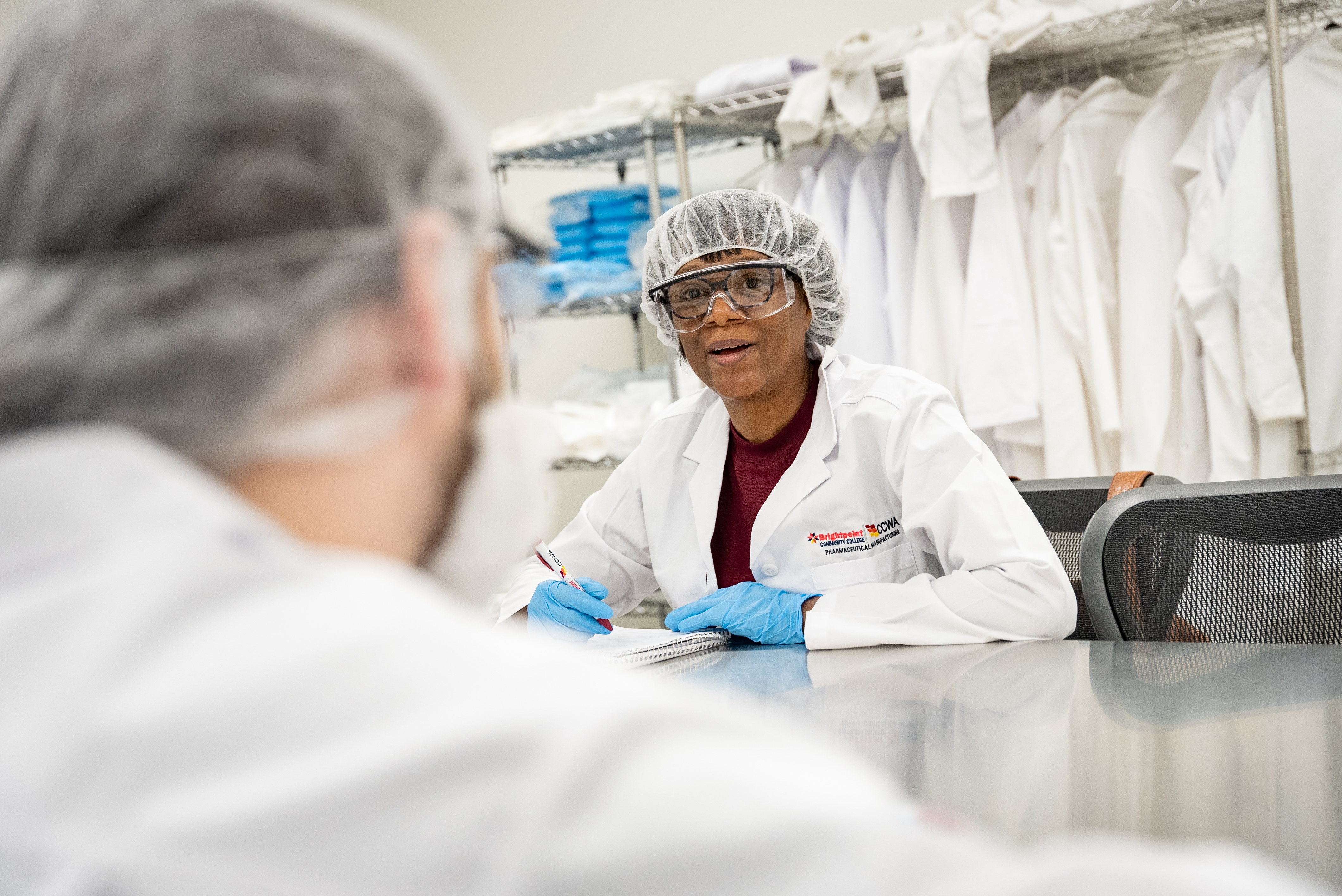
One of ABBM’s key partners is the CCWA, the shared workforce development division of Brightpoint Community College and Reynolds Community College. After a five-year development process, the coalition launched its pharmaceutical manufacturing training program in 2020 to prepare job seekers for entry-level production roles.
Dr. Cynthia Finley, director of CCWA’s Advanced Pharmaceutical Manufacturing Intermediary, describes the strategy as creating multiple on-ramps into the industry. The system now includes industry-recognized credentials, micro-credentials, and hands-on laboratory instruction tied to employer demand.
The entry-level pathway includes short-term programs where students earn credentials such as the Manufacturing Technician 1 and Pharmaceutical Manufacturing Technician certifications. Training focuses on safety protocols, chemistry fundamentals, documentation practices, and process math. For deeper preparation, Brightpoint offers a two-semester pharmaceutical career studies certificate, where students train in lab settings modeled on pharmaceutical cleanrooms.
“This particular sector is poised for micro-credentials,” Finley said. “You don't need a complete degree; you just need a little bit of training to get you to that next level.”
These credentials allow workers to advance while remaining employed. “Employers want students who can hit the ground running on day one,” she said. “That's what we’ve embedded into this design.”
Graduates move into roles such as manufacturing technician, quality control associate, quality assurance technician, chemist, biotechnology lab technician, and packing and shipping technician. Salaries range from roughly $40,000 to $100,000 per year.
Finley notes that 2025 served as a planning year under the Good Jobs Challenge grant, with broader enrollment and outreach expansion scheduled for early 2026.