Enabling Innovation
Across Virginia, local life sciences ecosystems are helping researchers connect with the funding and facilities they need to grow

Would more men try to prevent unintended pregnancies if their choices for contraception went beyond a condom or vasectomy?
That question propelled Kevin Eisenfrats to co-found a company in Charlottesville that has raised more than $30 million and inspired creation of an organization that’s become a model for the state.
Eisenfrats questioned why the responsibility for birth control was left to women when men are equal partners creating a new life. In 2011 at the University of Virginia (UVA), he met a professor and mentor, Dr. John Herr, who combined a love of science with a passion for entrepreneurship.
Eisenfrats had planned to go to medical school, but after four years as an undergrad working with Herr, the professor convinced him to stay and pursue his idea of a hydrogel implant for male contraception.
A decade later, Contraline has raised $35 million and is the “most advanced male contraception company in the world,” Eisenfrats said.
The product, known as ADAM, has been shown to be safe in a first-in-human clinical trial in Australia, and a phase 2 trial will soon be underway to measure effectiveness on 30 to 50 patients. If successful, Contraline would seek FDA approval for a phase 3 study — the final test on a much larger population that is a prerequisite to regulators granting approval for use. The company also now owns a daily, topical male contraceptive gel called NES/T, which has shown promising results in a global phase 2b trial.
Contraline is benefiting from the infrastructure and organization growing around UVA in the Charlottesville area. The company’s first chief operating officer, Nikki Hastings, co-founded CvilleBioHub, which has become a model for life sciences ecosystems in the Commonwealth.
In 2016, Hastings left Contraline to co-launch CvilleBioHub, whose mission is to grow the life sciences sector by supporting biotech startups and building infrastructure to commercialize academic research. She became its executive director in 2018.
Biotech is high-risk. Securing funding is critical, and funding sources change as a company launches, then grows. Early on, biotech might get funds from angel investors and government. Later, to scale up, companies might turn to venture capitalists who pool investments. For CvilleBioHub, the next goal is to raise enough funds to serve as an accelerator itself, in addition to the expertise and low-cost lab space it currently provides.
“Contraline is creative [at] finding holes in the market and saying, ‘Wait, there’s nobody playing in this space,’” Hastings said.
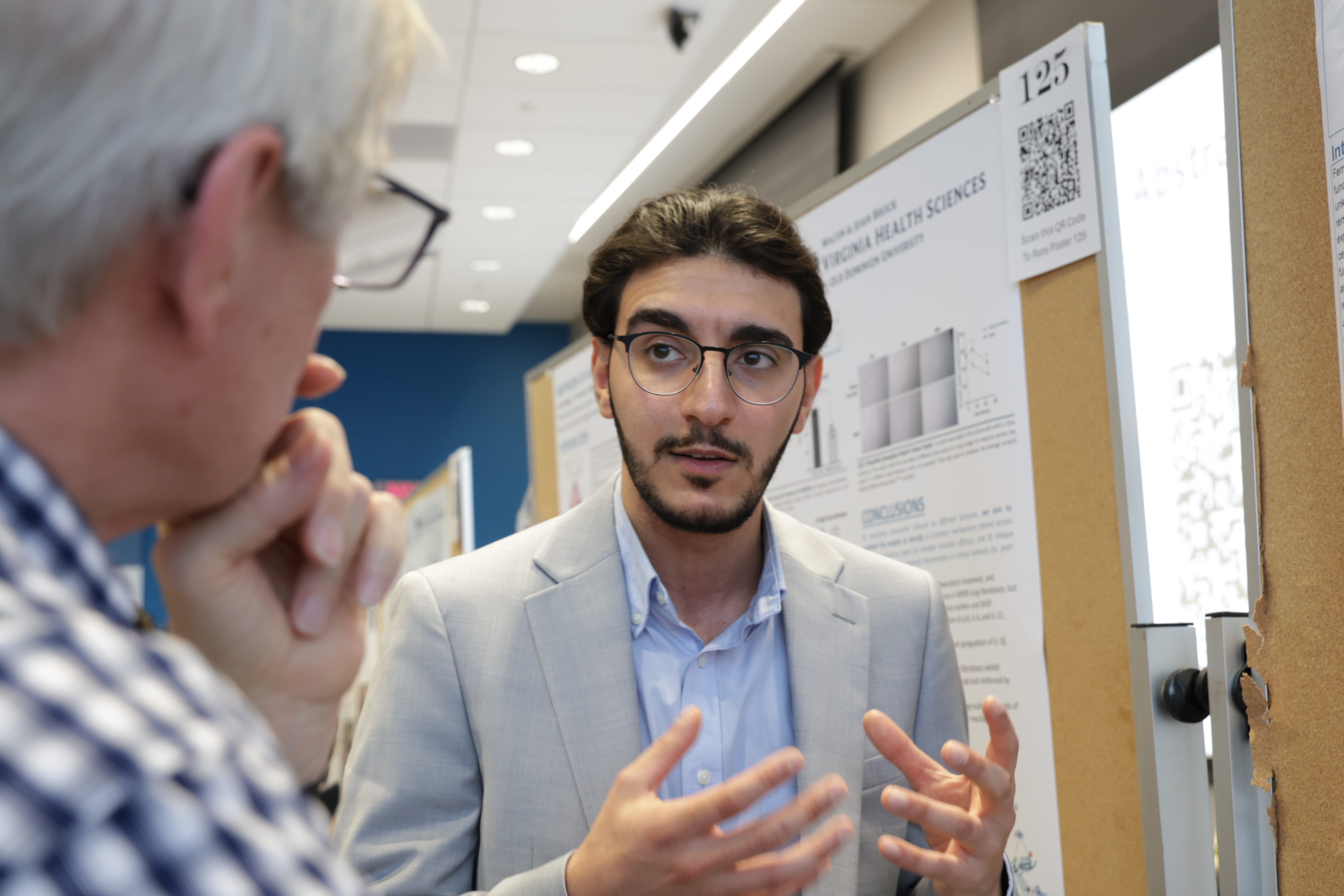
Eastern Virginia Medical School merged with Old Dominion University in 2024, creating the largest academic health sciences center in the Commonwealth.
It’s the United States’ second wave of growth and building for the biotech and life sciences industry, and Virginia is at the tip of that spear.
Nikki Hastings
Executive Director, CvilleBioHub
A MODEL FOR COLLABORATION
CvilleBioHub has become the model for the way Virginia is growing its life sciences industry, backed by funding from GO Virginia, a state economic development initiative supported by VEDP. In 2020, GO Virginia approved a grant, led by the Virginia Biotechnology Association and including CvilleBioHub, to help fund ecosystem support activities across four other regions that grow near anchor universities. These hubs are located in the Richmond-Petersburg area (anchored by Virginia Commonwealth University), Northern Virginia (George Mason University), Roanoke and Blacksburg (Virginia Tech), and Hampton Roads (Old Dominion University).
Richmond’s life sciences ecosystem is supported in part by Activation Capital, a state-created authority focused on growing the region’s life sciences and pharmaceutical innovation sector by helping translate scientific discoveries into commercial companies. In addition to providing lab and office space, Activation Capital supports founders through a continuum of entrepreneurship programs that guide companies from early concept through commercialization.
“I was attracted to Activation Capital as a vehicle to accelerate Virginia’s life science growth. With all the recent success and momentum, our next generation of leaders and innovators can look no further than the Commonwealth as the place to practice their craft or commercialize their inventions,” said Michael Steele, who took over as Activation’s president and CEO in 2025.
While Virginia Commonwealth University’s (VCU) pharmaceutical manufacturing innovations are attracting investment from major players in that industry, the region’s startup ecosystem includes a wide variety of companies. Tympanogen, a Richmond-based medical device company that developed a gel patch called Perf-Fix to repair perforated eardrums, recently completed a pivotal clinical study ahead of its U.S. Food and Drug Administration (FDA) filing for the product.
In the pharmaceutical manufacturing area, Phlow Corporation moved a step closer this year toward regulatory approval for U.S.-based manufacturing of epinephrine’s active pharmaceutical ingredient. Epinephrine is a hormone and medication that acts as a lifesaving first-line treatment for severe allergic reactions. It’s part of a broader mission for Phlow to onshore manufacturing for active pharmaceutical ingredients that now must be imported.
In Roanoke, researchers are using novel techniques to deliver medicines in more effective ways. Tiny Cargo, the first manufacturer to emerge from Virginia Tech’s Fralin Biomedical Research Institute at VTC (FBRI), uses tiny spheres from cow’s milk called exosomes to deliver medications to specific areas of the body.
FBRI, a partnership between Virginia Tech and Roanoke’s Carilion Clinic, continues to grow. Its latest priority is recruiting leaders to head Virginia Tech’s newest clinical research enterprise, the Patient Research Center, which will accelerate collaboration in biotechnology, life sciences, and pharmaceutical manufacturing.
“These changes represent a dynamic and growing community of scientists and physician-scientists focused on next-generation approaches to cancer, heart, and brain research,” FBRI Executive Director Dr. Michael Friedlander said.
Carilion also runs Carilion Clinic Innovation to commercialize Carilion innovations, and the Center for Simulation, Research, and Patient Safety, which houses Carilion’s makerspace with 3D printers for rapid prototyping.
“Our focus is on innovations with commercial potential,” said Troy Keyser in 2022, then Carilion Clinic Innovation’s director. “Not only might our patients benefit, but if we were able to license that intellectual property to, say, a medical device company that could bring the innovation to a larger market, patients across the country, if not the globe, could benefit. To get to that endpoint, we needed to make sure we had the right infrastructure to assess employee inventions to understand the commercial potential.”
With all the recent success and momentum, our next generation of leaders and innovators can look no further than the Commonwealth as the place to practice their craft or commercialize their inventions.
Michael Steele
President and CEO, Activation Capital
MERGERS CREATE RESEARCH POWERHOUSE IN HAMPTON ROADS
In the coastal Hampton Roads region, the largest academic health sciences center in the state, Macon & Joan Brock Virginia Health Sciences at ODU, took shape when Eastern Virginia Medical School (EVMS) merged with Old Dominion University (ODU). ODU and EVMS have their fingerprints on numerous key regional assets, including:
- The Hampton Roads Biomedical Research Consortium (HRBRC), a partnership between ODU/EVMS, Norfolk State University, and area hospital system Sentara Healthcare, which coordinates efforts across the region.
- The Shady Grove Fertility Jones Institute for Reproductive Medicine, a successor organization to EVMS’ Jones Institute, responsible for the first in vitro fertilization (IVF) baby born in the United States.
- The Frank Reidy Research Center for Bioelectrics at ODU, which has developed a way to diagnose and treat disease by researching how electric fields and ionized gases interact with living cells.
- Virginia Beach-based LifeNet Health, a global leader using biology and engineering to repair, replace, or regenerate human cells, tissues, and organs.

Among CvilleBioHub’s services to growing companies is its Device and Tech Expo, held for the first time in 2024 to showcase emerging technologies like Caretaker Medical’s wireless, noninvasive monitoring devices.
“We have all the right ingredients,” said Kevin Leslie, ODU’s first associate vice president for innovation and commercialization and former executive director of HRBRC.
Other regions of the Commonwealth are making similar investments. In Northern Virginia, George Mason University, Prince William County, and the city of Manassas combined their resources to launch an innovation district in 2025. The Prince William Science Accelerator, located in the innovation district, rebranded as Endeavor234 and has provided more than 20 emerging companies with lab space to launch and grow. The Northern Virginia Bioscience Center is a neighboring commercial wet lab facility designed to support companies that are scaling and in need of more space.
“One of our distinguishing features is that the Innovation District actually doesn’t only focus on the life sciences,” said Amy Adams, executive director at the Institute for Biohealth Innovation at George Mason. The Innovation District, which recently received a $3.9 million GO Virginia grant, also focuses on research in aerospace, defense, AI infrastructure, semiconductors, and forensic science.
“The convergence of people and ideas across disciplines, complemented by access to unique infrastructure, accelerates innovation, creating new jobs and thriving companies,” Adams said.
Its growing companies include Serpin Pharma, which seeks better ways to treat autoimmune responses that damage health. Its founder and CEO, Cohava Gelber, has ushered in a new drug, SP16, synthesized from a protein produced in the liver without triggering damaging inflammation. Among target uses for the drug are reducing the inflammation associated with heart attacks, avoiding or minimizing kidney injury that occurs when the heart stops during cardiac events and procedures, reducing pain experienced by cancer patients receiving chemotherapy, and rejuvenating aging skin — the last of which led to a partnership with cosmetics giant Estée Lauder Companies.
Serpin has raised more than $32 million to date. To further expand uses and complete third-phase trials, Serpin will seek a larger company to acquire it or license the use of SP16, a deal Gelber hopes could bring in $5 billion. For now, it’s working to fine-tune the processes and research that received a boost from the regional collaboration Gelber found in Prince William.
“It created a community for networking, discussions, collaborations,” she said. “You feel it. When I invite people to join me in one of these gatherings, they get very excited.”
Contraline, Tympanogen, Phlow, Tiny Cargo, and Serpin Pharma are just a few of the companies benefiting from state and regional efforts to grow the life sciences ecosystem in the Commonwealth. Through targeted investment and dedicated research, Virginia is emerging as a destination for startups and major expansions alike.
“It’s the United States’ second wave of growth and building for the biotech and life sciences industry, and Virginia is at the tip of that spear,” Hastings said.