
Virginia Works to Meet the Tech Moment
Key investments at Virginia Tech, George Mason, University of Virginia help the Commonwealth position itself as a home for AI Innovation
George Mason University
Three years after Open Ai launched ChatGPT, Virginia continues to capitalize on its position as a global tech leader to solidify its place in the AI industry. With over 31,000 AI-related job postings in 2024, Virginia ranked fourth nationally in the Stanford AI Index Report, trailing only states with far bigger workforce populations (Texas, California, and New York).
Decades of strategic investment in the technology sector have propelled the Commonwealth to the forefront of the global AI landscape. Dubbed “Silicon Valley East” by Business Traveler, Virginia is unmatched in highly skilled and concentrated tech talent, especially in Northern Virginia. In 2024, the Commonwealth had the third-highest share of technology companies (per WalletHub), and Business Facilities ranked Virginia’s tech talent pipeline third in the country.
Virginia’s position as a top state for tech talent is not by chance, but the product of significant historical and ongoing investments in its tech talent pipeline, including the landmark Tech Talent Investment Program (TTIP). Launched in 2019, TTIP is a $1.1 billion, 20-year commitment to increasing the number of BS and MS graduates in computer science and related fields by at least 30,000. TTIP was conceived as part of Virginia’s 2018 winning proposal to Amazon for its HQ2 facility, and institutions are using TTIP monies and other funding sources to fuel research, facilities, and programs dedicated to expanding and maintaining a robust and innovative tech talent workforce.
“As we expand our three campuses across Northern Virginia to create a thriving tech corridor from Washington D.C. to Prince William County, George Mason and our partners have been propelling the region together,” said George Mason University President Gregory Washington. “The Commonwealth is seeing an enormous return on investment as our students graduate at record numbers and stay to work in the region, helping to propel the state as a leader in business, nationally and globally.”
Establishing Northern Virginia as a Tech Hub
Over the life of TTIP, Virginia Tech and George Mason will each receive up to $400 million, with $250 million of funding dedicated to capital investment in Northern Virginia. As the primary TTIP recipients, both institutions established facilities near the National Landing area that’s home to HQ2.
Virginia Tech’s state-of-the-art Innovation Campus in Alexandria officially opened Academic Building One in February 2025. The 11-story, 300,000-sq.-ft. facility, just south of Ronald Reagan Washington National Airport and served by the Potomac Yard-VT Metrorail station, anchors the university’s growing presence in the region and serves as a hub for advanced research. The new campus also houses the Institute for Advanced Computing (IAC), designed to foster partnerships between industry and the federal government, enabling graduate students to tackle global-scale challenges through hands-on collaboration.
“As technology reshapes society, the expanding and evolving need for talent is one of our greatest challenges. Higher education can meet the challenge by giving students the knowledge and experience they need to seamlessly move from learning to leading as they join the workforce and take on real-world problems,” Virginia Tech President Tim Sands said.
The IAC will be home to faculty in core computing disciplines, including AI, machine learning, quantum computing, and next-generation wireless technologies. It will also support advanced applications such as intelligent interfaces and manage master’s programs in computer science and computer engineering.
“Rapid advances in computing, artificial intelligence, and security are transforming industry and economies,” Sands added. “As one of the leading producers of talent in the region, working hand in hand with industry and government partners, we can provide students with the hands-on skills they need for success now, and the ability to reimagine their role through lifelong learning as the workplace evolves.”
Lighting the Fuse
In fall 2024, George Mason opened its new Fuse at Mason Square complex in Arlington, a 345,000-sq.-ft. facility that brings together academics, students, industry experts, and tech entrepreneurs on a collaborative site that includes 50,000 square feet of lab space.
Recognizing the importance of interdisciplinary collaboration, Mason Square includes several grad schools and undergraduate programs with students studying cutting-edge technology under the same roof as those studying business, law, public policy, and government. The facility also includes access to a business incubator.
“You really can’t have innovation unless you have the computer scientists and the engineers working side by side with the lawyers and the policymakers,” said Liza Wilson Durant, George Mason’s associate provost for strategic initiatives and community engagement, echoing Sands’ assertion, “We thrive in interdisciplinary spaces where technology engages with biomedical innovation, business, engineering, and the liberal arts.”
“If you’re an entrepreneur and you have a new idea, there are usually some barriers, whether they’re legal barriers to policy or ethical barriers. You need all those social scientist partners, economists, and businesspeople working together to move the technology forward. A computer scientist or an engineer can’t do it alone,” Durant said.
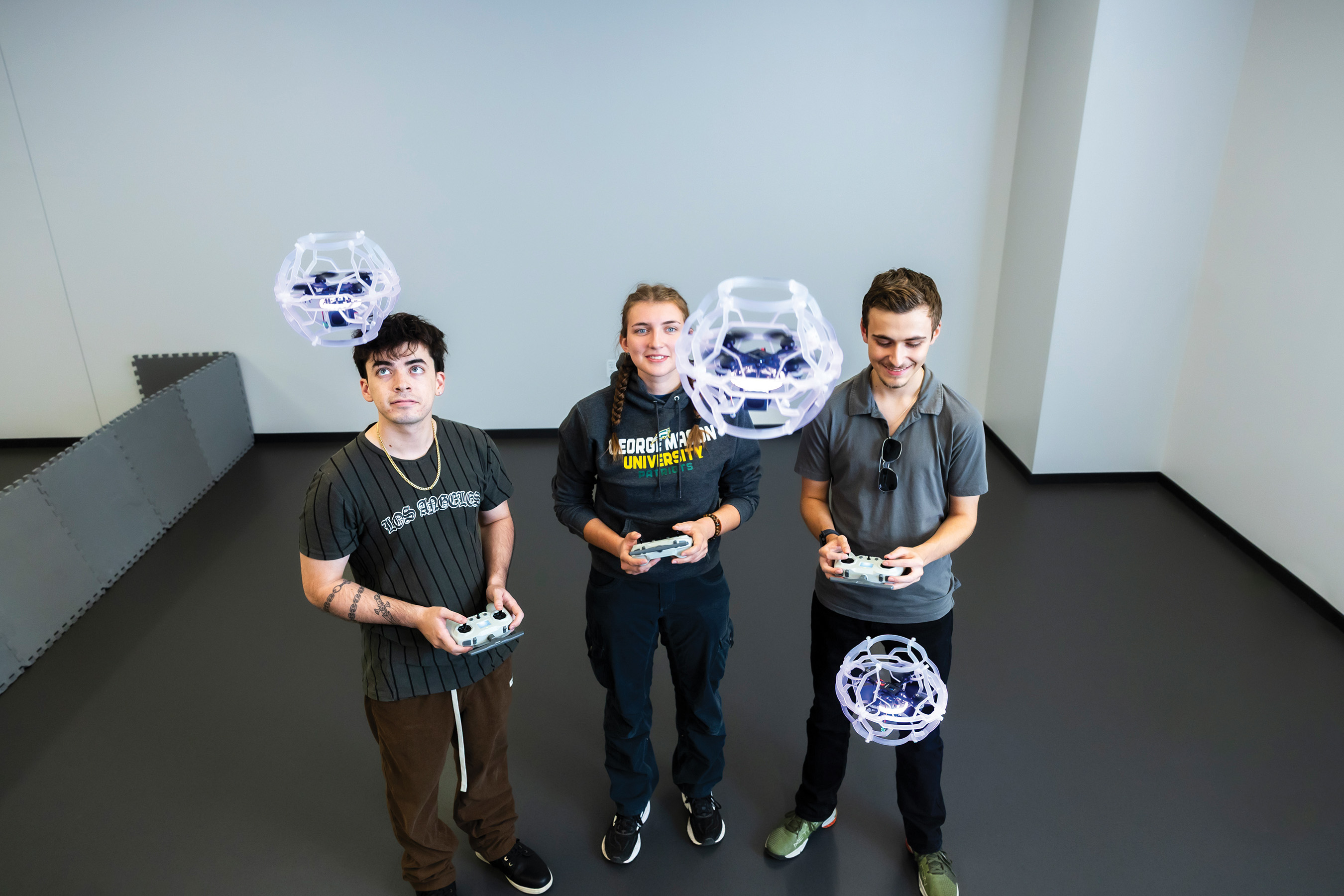
As an example, professors, students, and entrepreneurs applying electrical engineering and computing to construct robotics work closely with psychology faculty to understand how people best interact with robots.
George Mason and its partners have been hosting events at Fuse, the fourth building on the university’s Mason Square campus in Arlington, since early this year, and began holding classes there in August.
Recently, the university hosted a celebration opening the new Energy Exploration Center and honoring the transformational naming gift from Kimmy Duong and Long Nguyen for the university’s School of Computing and the establishment of three endowments to provide scholarships and match-funding initiatives aligned with TTIP. This fall, George Mason also began offering Virginia’s first public master’s degree of science in AI.
“George Mason was one of the first universities in the country to name a chief AI officer, an early indication of our comprehensive approach to incorporating AI to enhance learning, instruction, research, and administration across our campuses,” Washington said. “Those who can effectively and ethically use the technology will be strategically positioned for success.”

Virginia Tech
Statewide Effort and Innovation
The Commonwealth’s investments in tech talent are not limited to the northern part of the state. In the central region, the University of Virginia (UVA) is home to the first data science school in the country.
In 2018, UVA launched the dedicated School of Data Science after a $120 million donation from business school graduate Jaffray Woodriff, founder of Quantitative Investment Management. Last year, Scott and Beth Stephenson contributed an additional $10 million to fund a scholarship program for students pursuing a bachelor’s degree in data science. Mr. Stephenson graduated from UVA in 1979 and went on to found SGS Capital and serve as president and CEO of Verisk Analytics.
A key component of the data science school’s programming is connecting students and faculty to industry. Stephenson argues that the latter is host to most innovation, including innovation in AI. As an investor who sits on the boards of several private corporations, he encourages companies to “really take advantage of this generative AI moment that we’re in.”
That notion has already captured the attention of students, with more than 700 students at UVA minoring in data science.
Virginia Tech, George Mason, and UVA are spearheading many of the Commonwealth’s most publicized investments in tech talent, but they aren’t alone. Institutions across the Commonwealth are making significant contributions to the tech talent pipeline. Ten other institutions and the Virginia Community College System participate in TTIP.
A Focus on Retention
Virginia’s robust tech talent pipeline doesn’t end at graduation. In addition to producing high-quality talent, the Commonwealth is also committed to retaining talent, ensuring that innovation and expertise continue to flourish across the state.
Erin Burcham, president of the Roanoke Blacksburg Innovation Alliance and executive director of the Roanoke Blacksburg Technology Council, is leading efforts to keep more Virginia Tech graduates in the region and the state.
According to U.S. Census Bureau statistics, nearly half of Virginia’s college graduates leave the state after graduation to work elsewhere. At Virginia Tech, many tech grads are recruited to hubs in Nashville, Austin, and the West Coast, while biotech graduates frequently land jobs in Boston and San Diego.
“They were being scooped up,” Burcham said. “So, we are really focused on helping very technical talent get connected to Virginia employers.”
To address this challenge, the Roanoke Blacksburg Technology Council launched ChangeMakerZ in 2023, a 10-month development program for early-career (3-7 years post-grad) biotech and technology professionals looking to network and boost career skills.
The council is also hosting its second emerging technology conference, focused on retaining talent already in the Commonwealth and attracting professionals from other states.
“We’re advertising out of state for people to come to Virginia for this conference to find new opportunities to work,” Burcham said. “It’s not simply a matter of growing the pipeline through education. It’s about growing that pipeline and creating programs and supports so that more of that talent stays in the region.”