
The Gen Z Talent Conundrum
The newest workforce cohort brings tech savvy and tremendous upside to the economy — if it can overcome some systemic challenges
As more tenured employees must upskill and reskill to adjust to an economy that is increasingly reliant on technology and, specifically, artificial intelligence (AI), Generation Z workers are entering the labor market as the first generation of digital natives. McKinsey & Company describes Gen Zers as “extremely online,” living much of their lives, including work, through technology. While there is significant concern about the amount of time younger generations spend on devices, these ingrained technological skills can also provide an advantage in the workforce.
At the same time, while technological innovations have changed the hard skills companies are looking for in new employees, some workforce skills (e.g., soft skills) will always be in demand.
Noah Porter, a mechanical engineering student at George Mason University, is firmly in the middle of Gen Z. As part of his studies, Porter is interning with Newport News-based Eagle Aviation Tech, a company that can appreciate both his Gen Z technological skills and his soft skills like punctuality.
“The internship got me moving in the morning,” said Porter, who resisted the snooze button at 7 a.m. every day and got ready for work. “I was getting up and being more productive.”
Porter and his Gen Z peers are entering the job market with a unique set of skills, but they also must navigate a multigenerational workforce and a difficult economy.
Economic Hurdles for New Workers
Porter and his Gen Z peers face strong economic headwinds. According to the World Economic Forum, entry-level job postings dropped 29% between January 2024 and September 2025, and the unemployment rate among workers 16–24 jumped to 10.5% in August 2025.
The once-certain pathway from college to a promising career isn’t guaranteed for Gen Z workers, who are projected to make up 30% of the U.S. workforce by 2030, according to the U.S. Bureau of Labor Statistics. Recent college graduates face greater headwinds than they have in the past. Data from the Federal Reserve Bank of New York indicates that the unemployment rate of college graduates aged 22–27 is higher than that of all workers of all ages for the first time in recent memory, although still lower than that of all workers in that age range.
“Thirty years ago, parents who could were pushing their kids toward a four-year college degree in order to improve their long-term employment prospects,” said Sonya Ravindranath Waddell, vice president and economist at the Federal Reserve Bank of Richmond. “But a large share of students who start a four-year degree don’t finish in six years, and college enrollment is on the decline, due not only to the smaller population of 18-year-olds, but also due to students choosing to enter the workforce after high school or choosing shorter-term programs or apprenticeships.”
Of course, finding a place in the workforce is not just a challenge for Gen Z. It is a more general issue for workers entering the labor market after a long absence or for the first time, including Virginia’s sizable veteran population. Fed Chair Jerome Powell recently described the job market as“low-hire, low-fire” — where a low but rising unemployment rate of 4% masks the underemployed, workers with side hustles, and those who have given up on their job search.
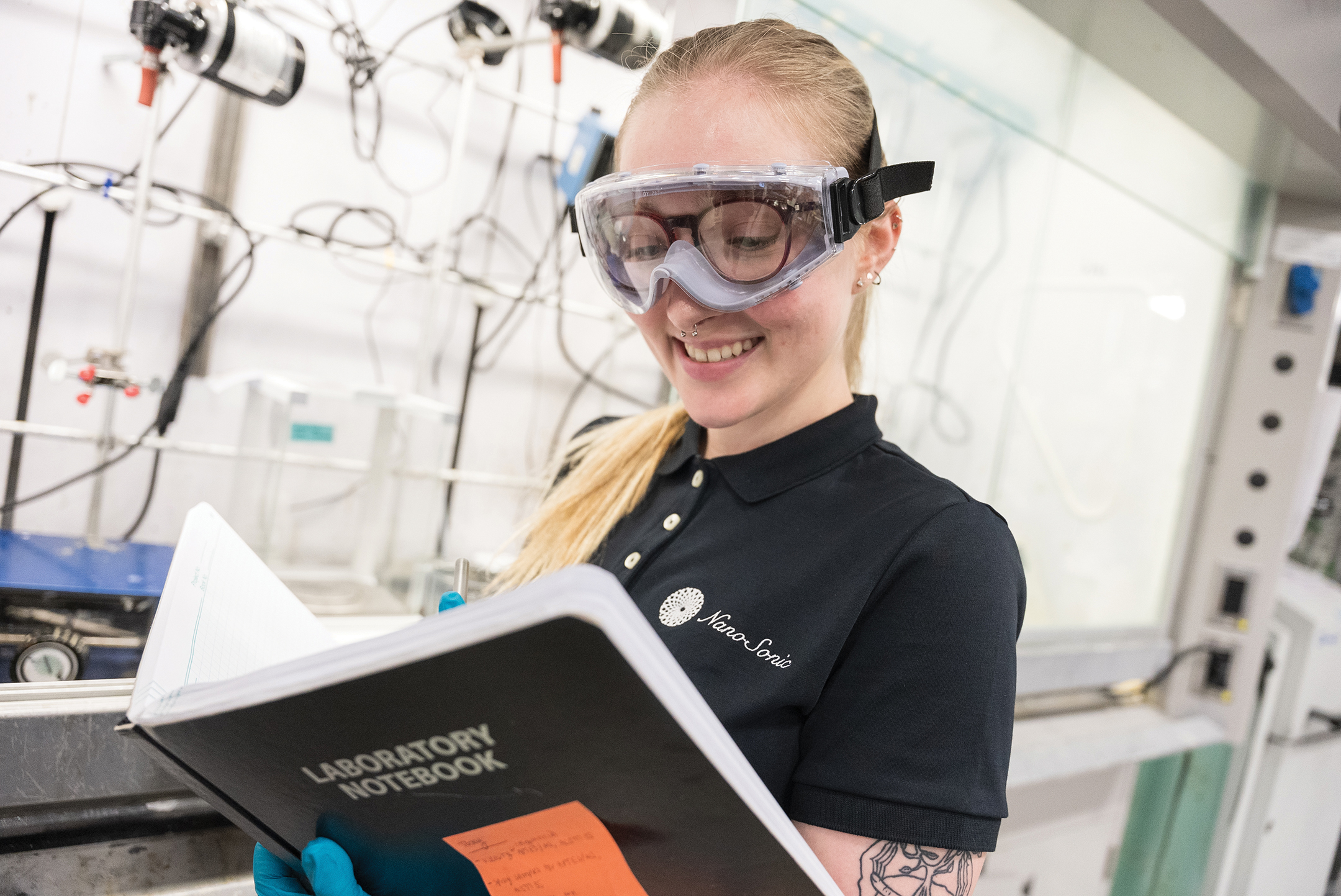
NanoSonic, Inc., Giles County
Defining Generation Z
There is no official designation for when a generation begins or ends, but most research and marketing firms define Gen Z as those born between 1997 and 2012. While each generation is composed of unique individuals, those in the same generation share many of the same defining cultural moments that help to shape traits and values.
“What makes a generation is shared cultural experience,” said Christina Brooks, senior director for community initiatives at the Hampton Roads Workforce Council (HRWC).
For Gen Z, the most obvious unifying cultural experience to date has been the COVID-19 pandemic. Porter missed in-person learning from the end of eighth grade into high school. At the same time, older members of Gen Z were navigating a job market that had suddenly gone remote.
The age of technology also helps define Gen Z.
Dr. David Doré is the chancellor of the Virginia Community College System (VCCS) — comprising 23 colleges and an annual student population of more than 200,000.
“They’re the first generation who have only known the digital age,” Doré said. “There’s this notion of mobile-first communication. Anytime, anyplace, any-format learning.”
These experiences — the pandemic and digital age — and others have helped shape a generation that, according to McKinsey & Company, are more pragmatic, individualistic, and politically and socially active than their older colleagues (millennials).
Brooks pointed out two other commonalities, “One of the superpowers of Gen Z is collaboration — working with peers and working with groups — and one of the other most remarkable characteristics about Gen Z is they’re more diverse than any previous generation.”
Gen Z’s knowledge of, utilization of, and relationship with AI may be what makes them most distinctive. “Gen Z students are incredibly tech-fluent,” Doré said. “In some instances, Gen Z students are coming in a whole lot more comfortable with AI.
Porter uses AI as a tool to brainstorm, rather than a turnkey solution. “I use it to help me organize my thoughts more,” he said.
Careers Built On Values
Education and workforce leaders are committed to capitalizing on Gen Z’s strengths and values to help smooth their transition to the workforce.
According to Doré, Gen Zers are motivated by “relevance and purpose.” He continued, “They desire early career exploration and clear wage outcomes.”
Michelle Williams, talent and digital strategies program manager at the Roanoke Regional Partnership, also highlighted the generation’s interest in authenticity and livability: “When you pair that with a career, where your life is going, and livability, that really matters to them.”
Brooks agrees. The students she works with care about the potential for upward mobility as much as the salary.
More than other generations, Gen Z cares about building careers and lives, not just finding their first job. Companies that recognize the potential of Gen Z to contribute to their culture and bottom line can attract workers by catering to these values.
Wells Fargo took that into consideration when expanding operations in Roanoke County. The global financial institution announced an $87 million expansion in 2023, detailing plans to add 1,000-plus jobs to its current regional workforce of 1,650. The company chose the Roanoke area in part because the leadership believed in the region’s ability to attract and retain the younger workers who will form the core of its workforce moving forward.
Gen Z is “starting to choose locations partially because of the idea of having entertainment options that are relatively inexpensive, or even free, which means that a lot of outdoor activity is really important to them,” said Brian Corde, managing partner at site selection firm Atlas Insight, who led the Wells Fargo project. “We see where people are going, and a lot of people are choosing to leave urban areas for locations that have a lot more open space, a lot more sunny days, and a lot more ability to keep more of your income in your pocket.”
Shawn Avery, HRWC’s president and CEO, has some advice for other employers and workforce partners who are ready to welcome Gen Z. “You’ve got to figure out how you communicate to those generations,” he said. “But I think we all have the same mindset. We want to do a job, and we want to do it well.”
Porter certainly shares that sentiment. A willing ambassador for Gen Z at his Eagle Aviation Tech internship, he’s eager to help out his millennial and Generation X co-workers. “I’ve got better knees,” he joked.
With Generation Alpha entering middle school, it won’t be long before Porter and his fellow Gen Zers are working alongside an even younger generation. But for now, all eyes are on how Gen Z can contribute to the workforce and economy.