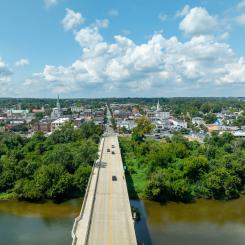
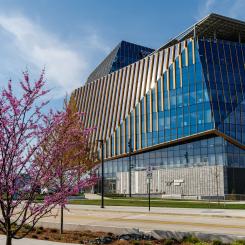
Langley Research Center in Hampton is the oldest of NASA’s field centers. Comprising nearly 200 facilities, it employs nearly 3,400 civil servants and contractors, and its researchers have been responsible for major advances in aeronautics and space flight. Dr. Trina Dyal is Langley’s director and Kevin Rivers is director of its Space Technology and Exploration Directorate. VEDP President and CEO Jason El Koubi visited Langley and spoke with Dyal and Rivers about Langley’s rich history, its role in the 2026 Artemis II mission, and future priorities, including the human mission to Mars.
Jason El Koubi: It’s been an amazing day here at NASA Langley. Can you give us some background on this incredible facility? How does it fit in to the big picture? What is its role in advancing the NASA mission and the aerospace and aviation industries?
Dr. Trina Dyal: NASA Langley was the first federal aeronautics research facility. We were established in 1917, so next year will be our 110th anniversary.
We started out learning how to fly through the atmosphere, in aeronautics. Then we learned how to fly beyond Earth’s atmosphere — the birth of space exploration. Then we learned how to fly back through the atmosphere to return astronauts safely home. Our role for NASA and the nation is to learn how you fly through atmospheres, and we’ve been doing that for 110 years.
Kevin Rivers: A lot of innovations everyone takes advantage of when they fly were initiated here at NASA Langley.
El Koubi: Our readers might already be familiar with NASA Langley, based on the Hollywood treatment you got about 10 years ago with the movie “Hidden Figures,” which is based on a book. Incredible history. Are there other stories that might make good movies?
Dyal: We often think about the legacy of NASA Langley, and honor and respect the contributions of our hidden figures. That was a pivotal moment in our heritage, but we also think about NASA Langley advancements as a timeline. I would call it a documentary more than a movie, because what we want to talk about is the ability of these brilliant researchers, scientists, and engineers to look beyond today to what’s possible. What don’t we know, and how do we fill in those knowledge gaps?
What is yet to come is actually the stuff we get to work on today, because it takes a good 20 to 40 years to advance what you need to do in the future. We get to do both what has been and also what can be. It’s pretty remarkable.

El Koubi: Often with major technological breakthroughs, spillover effects end up in other parts of society — some of which touch average U.S. citizens today. How has work here touched the aviation industry, and maybe even gone beyond that?
Dyal: The grooves in every runway and the national highway system are Langley inventions. We implemented that technology trying to solve the problem of aircraft hydroplaning on runways. That’s an application of steel we were using in the Viking Rover and parachute systems. We worked with Goodyear, and now that steel’s part of all radial tires. So, it also advanced the durability and safety of tire systems.
The insulation for wiring now in every pacemaker was invented by NASA Langley Research Center as we tried to find ways to protect sensitive wiring from radiation and thermal conduction. When you think about advances of NASA Langley for missions, the transference of that technology for the benefit humanity is tenfold.
Rivers: We’re working closely with the United Network for Organ Sharing, which is headquartered in Richmond, to bring organ transplant transportation through autonomous unmanned aerial systems or drones to significantly reduce cost, accelerate delivery, and make more viable organs available to more donor recipients who need them.
We’re very excited about all the technologies required to enable that. We’ve got to be able to fly autonomously in national airspace, which is a huge challenge. And then we also have to successfully deliver fragile organs in an appropriate state for transplants.
Dyal: NASA is exploring beyond what any human has ever done before, and we’re saving lives as we do it.
El Koubi: You’re building the future in all kinds of ways. A major part of that effort is the Artemis mission. As I understand it, Artemis is really about a long-term goal of sustainably establishing human life away from Earth. The Artemis II mission earlier this year was a major step in the broader Artemis mission. Artemis II was a 10-day lunar flyby, which I believe set a new distance record for human space travel.
Langley had a huge role, from preparation to execution of Artemis. How does Artemis II fit into the bigger goal of establishing sustainable human life away from Earth?
Rivers: If you’re going to far distant locations, you must first go through the atmosphere. We developed the aerodynamic database for the Space Launch System, the large rocket we flew. We also led development of the launch abort system.
We’re concerned about human safety and developed the system that safely removes the crew in some sort of catastrophe. Unlike Apollo, this system is capable of removing the crew through the entire flight regime all the way up to near orbit.
We’ve been closely involved in guidance, navigation, and control. We’re focused on returning successfully. We helped ensure that the heat shield for Artemis II would perform appropriately — which, by the way, it did.
Dyal: This was the first time in over 40 years humans left the terrestrial surface. We were sending them 252,000 miles, the farthest distance we’ve ever gone. It’s a tremendous responsibility and technological achievement that hadn’t yet been done, and we did it. The technologies and capabilities necessary for that mission’s success happened here at NASA Langley. For 20–40 years up until launch, our teams looked at every dataset that would ensure we launched the astronauts safely.
We have a Flight Readiness Review, where the agency brings all of its senior leaders together to discuss whether we’re ready to send these astronauts into space. I had the privilege of being one of those individuals at the table. We spent two days together, talking about the mission’s complexity.
Are the machine or the workforce radios mission control ready? Have we assessed all the risks that could possibly affect this mission? At the end of that meeting, every member is polled: “Are you go for launch?” Think about the responsibility of sitting at that table, and your voice is one of those in the room saying, “Langley is go for launch.”
That was powerful, because that’s a moment where you say, “I believe in our teams. I believe in the work we’ve done. I believe in this mission. The astronauts are ready, and I’m going to stand behind this Langley team to say, ‘We’ve done what’s necessary to bring this crew home.’”
El Koubi: What were your emotions after the mission was a success?
Dyal: I’m going to Kevin. He’s so humble about this. Kevin led the launch abort system design and development for Langley, so I can imagine it was a pretty powerful moment for him.
Rivers: We have a small scientifically calibrated imagery team we call SCIFLI. They capture high-definition imagery videography across the full visible and infrared spectrum of the launch and reentry so we have the information to inform future flights and designs.
I asked them, “Did you capture the jettison of the launch abort system?” They smiled huge smiles and said, “Oh, you’re going to love this.” I sat and watched that abort system performing exactly as it had been designed to.
You could say, “Well, you know, it didn’t do anything.” And I’m saying, “It did exactly what it was designed to do. It got out of the way so this mission could proceed.” The emotion was just real — to think that I had a part in that, and to watch it perform, and to know the historic significance of this mission, and to be as captivated as the rest of the world.
Dyal: And to know it’s a stepping stone. We had a remarkable accomplishment of sending four humans beyond anything we’ve ever done before. As soon as you return, you’re ramping up again. You get to celebrate, but you’ve got to get ready for what’s next. That’s what keeps us motivated every day.
NASA Langley doesn’t achieve in isolation. Everything we do, it’s because we have the strength of partnerships, whether with industry, academia, or other NASA centers. Everything we do is a collaboration of the brightest minds we can bring to bear on a problem.
Dr. Trina DyalDirector, NASA Langley Research Center
El Koubi: This feels like a good time to ask about NASA culture and Langley culture. One thing that’s so impressive to me is the way your broader mission and purpose are embraced by people. You can walk the streets of any major city anywhere in the world, and eventually you’re going to run into a person, often a young person with a bright future ahead of them, wearing a NASA T-shirt. It has tremendous cultural power — a power to inspire. What’s it like to live inside that culture?
Dyal: I can think of a couple of things. First, when you have a mission to benefit humanity, that’s a pretty audacious goal, transcending countries, demographics, and language barriers. When your goal is to benefit humanity — whether that’s exploring beyond Earth’s atmosphere, technology development that keeps humans safe, understanding what’s in our atmosphere that affects human respiratory systems so every human on this globe can breathe easier that transcends any barriers. But NASA Langley doesn’t achieve in isolation. Everything we do, it’s because we have the strength of partnerships, whether with industry, academia, or other NASA centers. Everything we do is a collaboration of the brightest minds we can bring to bear on a problem.
I think that’s the strength of what the NASA meatball logo represents — its brilliance, collaboration, excellence, integrity, and its teamwork. All of it creates that beautiful NASA bubble we get to explore in every single day.
El Koubi: Many technologies developed and demonstrated in the recent Artemis II mission have great relevance for the future. Can you talk about how the recent mission and other endeavors will inform the future of not only space exploration, but habitation?
Rivers: We talk about this opportunity to build the space commerce community, if you will, and participate with industry and academia to see it happen. So many things can happen in space. Products can be produced that make life so much better — medicines, silicon electronics, fiber optics, and other technologies. Everything we do builds toward that capability. We’re innovating and advancing technologies to enable missions that could also enable commercial ventures.
We’re building on it every day, and not doing it alone, but in partnership. We work closely with companies to enable these technologies, and we’re very excited and sometimes surprised by actual outcomes.
Dyal: We often talk about build tests and how to build an artifact. You’ve got to test it, put it in a relevant environment, and learn from it. That’s what creates a cadence of success and learning, because you’re constantly determining what you don’t know about a system, how it performs, where your gap in knowledge is, and how you need to fill it with another test.
It’s all about keeping humans and the American public safe. As we continue to explore beyond what we’ve ever imagined, it’s all a building block.
El Koubi: Speaking of building blocks, I know a lot of readers think about the idea of going to Mars. How is our progress toward that goal and how does Langley fit in?
Rivers: We have an established continuous human presence in low Earth orbit. I believe we celebrated 25 years on the International Space Station. But here’s the thing. That system is still what we would define as Earth-reliant, meaning if there’s an emergency, you can return to Earth quickly. If you break something, you can repair it easily. When you’re on Mars, you’re not going to have any of those capabilities.
Everything you do on Mars will have to be done there. If there’s illness, you’ve got to have medical support. If something breaks, you’ve got to be able to replace it, fix it, or mitigate it there because you can’t deliver the replacement quickly. It’s a six- to nine-month trip to Mars.
What we’re doing next is establishing a permanent presence on the moon. When you move out to cislunar space now, you start to get to that point where you can be Earth-independent. But you’re still close enough that if there’s a true emergency, you can safely return to Earth.
Permanent presence on the moon will enable us to learn what we need to know about how you operate in an Earth-independent environment. It will allow us to build and demonstrate technologies that enable us to go to Mars.

El Koubi: Are there certain things about your work that you wish the public understood better?
Dyal: We talked earlier about the complexity of what it means to leave Earth’s surface. A lot of times when I’m talking to my neighbors right across the fence line, I have to tell them to suspend what you know about working on Earth, because not all of those principles apply when you leave Earth’s surface.
Many times, you don’t have gravity, or an atmosphere. Or precision necessary to do the most simple tasks. Fluctuations in temperature beyond Earth’s atmosphere are extreme. I would love for folks to embrace the complexity and challenge of what it means to leave Earth’s atmosphere and the enormity of being able to solve those problems. Employees at NASA, specifically at NASA Langley, come to work to do just that, to suspend what you know about working on Mother Earth and figure out what it means to go beyond.
El Koubi: What does that mean for your mission going forward? For the public-private partnerships?
Dyal: We’re here as subject matter experts to unleash potential, whether it’s in our workforce toward a NASA mission, or whether it’s toward making our partner companies better at what they need do for their markets.
In that vein, in Virginia, we have a 9-to-1 return on investment in workforce; nine employees benefit throughout the Commonwealth. In financial investment terms, there’s a 4-to-1 return. On every $1 million NASA puts into the economy, the benefit is fourfold to the Commonwealth.
NASA Langley is a force multiplier for the Commonwealth. We’re here to not only unleash the potential of what we can do to advance what’s beyond, but also to help partners within the Commonwealth achieve their goals and unleash their potential.
Rivers: Commercial partners may have other applications, which could be commercial or military. A lot of times, if a company is interested in doing something for NASA, we can be a great partner. But if they’re thinking of doing something for the Department of War, we can also be a great partner, with amazing assets and capabilities. We have deep subject matter expertise to help them solve those problems, and that gets our folks excited.
We have connections to other government agencies we can leverage to enable someone to be successful, whatever their endeavor is.
Dyal: We at NASA Langley also have responsibility for some of the nation’s unique wind tunnel facilities. If you have an artifact where you’re trying to understand performance or do a risk posture on, we have unique facilities that exist around the globe right here on this campus. In addition to subject matter expertise, we have unique, capable ground test facilities we bring to bear to solve problems.
El Koubi: I want to build on that. You’re part of a space ecosystem in Virginia with an extraordinary array of assets. So much innovation related to space happens here, and you’re a huge part of the research and development. But you’re not alone. Many companies are engaged in space innovation and R&D.
Virginia also has a huge manufacturing sector. Many components and products you need to successfully operate in that environment are designed and built here. It’s also one of the few places in America where you can launch rockets into space. Wallops Island on the Eastern Shore, a vertical launch facility, is a rare asset.
NASA Langley Research Center is an anchor in that ecosystem, and so many of the other players are here because of your incredible capabilities and expertise. How do you engage with the private sector? Why do you see so many private sector companies locating in proximity of NASA Langley as they execute their own missions?
Dyal: I liken it to a think tank. Our job is to think about what can be done to solve problems no one else is going to solve, to collaboratively work through what we don’t yet know. That’s a strong draw for corporate America, who’s trying to accelerate advancements in their commercial markets and sectors.
We naturally have a culture that enables ecosystem acceleration. We also have an organization called the Strategic Partnerships Office, our front door. If you would like to work with NASA Langley Research Center, you approach us through the Strategic Partnerships Office. They start conversations to make sure we have all the necessary expertise and capabilities a company or partner needs. We make it as easy possible to be available for NASA and the nation.
So many things can happen in space. Products can be produced that make life so much better medicines, silicon electronics, fiber optics, and other technologies. Everything we do builds toward that capability.
Kevin Rivers
Director, Space Technology and Exploration Directorate, NASA Langley Research Center
El Koubi: Speaking of this extraordinary ecosystem, one thing that’s always a big part of it when you’re talking about Virginia, regardless of industry, is our extraordinary talent base. We have leading universities, leading research, and great public schools for businesses looking to locate and expand. We have the top customized workforce recruitment and training solution anywhere in the world. How are those partnerships for you, and how does that benefit NASA Langley?
Rivers: People ask me, “How did you find your way here to NASA Langley?” I’m from South Carolina. When I was a freshman looking for a summer job, there was a thing called cooperative education.
I remember sitting at home on Christmas break getting a call from the coordinator, saying, “Hey, Kevin, we’ve got a great opportunity for you to go to work for NASA.” I was so excited. I had the original astronauts’ poster on my bedroom wall.
I showed up on that first day and fell in love with this place, the culture Trina has talked about. I knew this was where I was going to be for the rest of my career.
I’ve been here almost 40 years. We find that story across so many people, either folks coming in from other states, or folks from right here in Virginia. As you mentioned, we have some of the best aerospace universities in the country in Virginia, and we’re super excited about working with them and bringing their students in through pathways programs, internships, and engaging them in so many ways.
Dyal: We love to find talent wherever it comes to us. And as Kevin said, we have remarkable talent, remarkable universities, in Virginia. I’m an adjunct professor at Old Dominion University. My advanced degree is from Old Dominion University, and being part of the university system allows you to explore all the opportunities we have.
It’s not just at the university level. We engage a lot of the community colleges and talent that exists in the trades. We need lawyers and folks who understand contracting, procurement, and finance. We need all skill sets to make our mission successful. And that talent sits right here in the Commonwealth.
El Koubi: The ecosystem is amazing. It’s a place where you can design it, build it, launch it, and operate it. I think part of that is because it’s an incredibly diverse ecosystem of businesses, but also where you have truly world-class talents, and you are investing in the next generation.
Thank you for your extraordinary leadership of this incredible research and development asset that’s literally helping to write the next chapter of so much of innovation, space exploration, and interests that bring humanity together. It’s been a true privilege and a lot of fun to learn more about it today. And there’s so much more to come.